


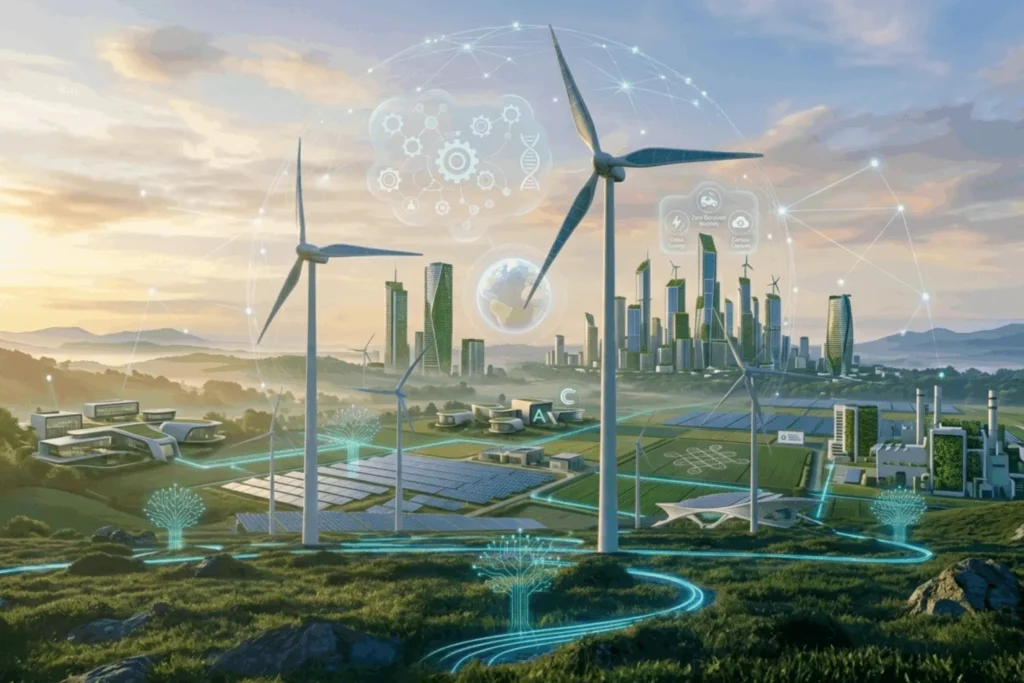
Backed by indigenously developed technologies and bold policy frameworks, India is not only accelerating its domestic transition but also positioning itself as a global leader in clean energy innovation by 2030. What sets this journey apart is the growing convergence of policy, deeptech, and entrepreneurial momentum, creating a powerful ecosystem focused on climate action.
India’s climate tech ecosystem is attracting strong backing from a diverse mix of investors, from venture capital firms like Omnivore, Avaana Capital, Blume Ventures, Bharat ClimateTech Initiative and Green Frontier Capital to impact-driven players such as British International Investment and Social Alpha. Climate Angels is another important name in this domain. It is India’s largest climate-tech focused fund connecting startups with investors. With a strong focus on decarbonization, sustainable agriculture, and renewable energy, early-stage momentum is being powered by networks like Climate Angels and Sangam Ventures, signalling growing confidence in India’s green innovation landscape.
The ClimateTech Boom
The ClimateTech sector in India has reached scale faster than many expected. In the early 2020s, ClimateTech investment was nascent. By 2025, funding reached approximately $2.8 billion across key startups according to Impact Investors Council reports, more than doubling from early 2020s levels amid policy support and renewable energy surges, while broader energy transition investments hit around $62 billion according to EY, propelled by e-mobility, solar, and net-zero ambitions targeting 2070.
Close to 1000 startups are now working across clean energy, mobility, agriculture, water, and industrial decarbonisation. This growth is driven by real-world challenges that cannot be solved with software alone. ClimateTech demands deeptech innovation; spanning advanced materials, energy storage, carbon capture, precision agriculture, and climate modelling.
Startups and innovators are increasingly leveraging artificial intelligence, machine learning, and data analytics to accelerate climate solutions. AI is being used to optimise renewable energy grids, predict weather and climate risks, enhance crop yields with precision farming, and monitor emissions in real time. Deeptech startups are also building breakthrough solutions in areas like battery technology, hydrogen fuel systems, and low-carbon industrial processes—turning sustainability into a scalable business opportunity.
From agritech platforms helping farmers reduce water and fertilizer use, to mobility startups enabling electric and shared transportation, India’s innovation ecosystem is actively shaping a greener tomorrow. These ventures are not just addressing environmental challenges but are also unlocking new economic pathways, job creation, and global competitiveness.
IIM Ahmedabad’s Bharat ClimateTech Initiative has backed and nurtured innovative startups including Onnes Cryogenics, Maini Renewables, PeakAmp, Chara Technologies, Unverse, and Terracarb, reflecting its strong commitment to entrepreneurship and deep-tech innovation.
Google and India Collaborate
In a significant step forward, Google has partnered to launch the Google Center for Climate Technology on Manthan, the Principal Scientific Adviser’s flagship platform for supporting India’s research and development ecosystem.
The Google Center for Climate Technology (the ‘Center’) is envisioned as a national catalyst to accelerate decarbonization and the evolution of climate technology. By providing access to sustainability-focused AI models, APIs, and technical expertise, the initiative aims to empower researchers, startups, and innovators to build scalable, impactful solutions.
The Center will support advanced research and foster cross-sector collaboration across academia, industry, and government. It is initially inviting proposals across three critical frontier areas where AI and deeptech can drive significant impact:
- Building a green workforce: Equipping the next generation with digital, AI, and climate-focused skills required for the transition to a sustainable economy.
- Sustainable aviation fuel (SAF): Accelerating innovation in sourcing, production, and deployment to decarbonize one of the most complex transport sectors.
- Low-carbon construction: Advancing research into next-generation materials and construction practices to reduce the carbon footprint of India’s rapid urbanization.
As India continues to scale its climate ambitions, the intersection of AI, deeptech, and startup innovation is becoming a defining force. With strong policy backing, increasing capital inflow, and a vibrant entrepreneurial ecosystem, the country is not only addressing its own sustainability challenges but also contributing meaningfully to the global fight against climate change, paving the way for a cleaner, greener future for planet Earth.
All Content Rights Reserved by Catalyst.